
You are funding your clients’ renovations whenever you pay for labor, materials, and subs before the homeowner pays you for that work. The fix is to line up your payment schedule with your costs, so each payment lands before or right after the money goes out, not weeks later.
Most remodelers feel this as a business that looks profitable on paper but is always short on cash. This guide shows where the cash gap comes from, six ways to close it, and a 15-minute weekly check that warns you before you have to cover payroll from your own account.
Signs you are financing your clients’ jobs
If two or more of these sound familiar, your cash is working for your clients instead of for you:
- You put cabinets, windows, or tile on your credit card and wait weeks for the matching payment.
- Payroll day makes you nervous even in a busy month.
- Your biggest payment comes at the end of the job, after most of the money has gone out.
- Change orders get billed with the final invoice.
- You send invoices days after a milestone, not the same day.
- You start the next job’s material order with money from the last job’s final payment.
- You have more work than ever and less cash than ever.
That last one is the clearest sign. Growth makes a cash gap bigger, because each new job needs money up front before it pays you back.
The cash gap: where your money goes before theirs comes in
Take a $60,000 kitchen with $45,000 in costs. The chart tracks your cash position on the job each week under two payment schedules: a back-loaded one (10% deposit, 40% at the midpoint, 50% at the end) and the milestone schedule from our progress billing guide.
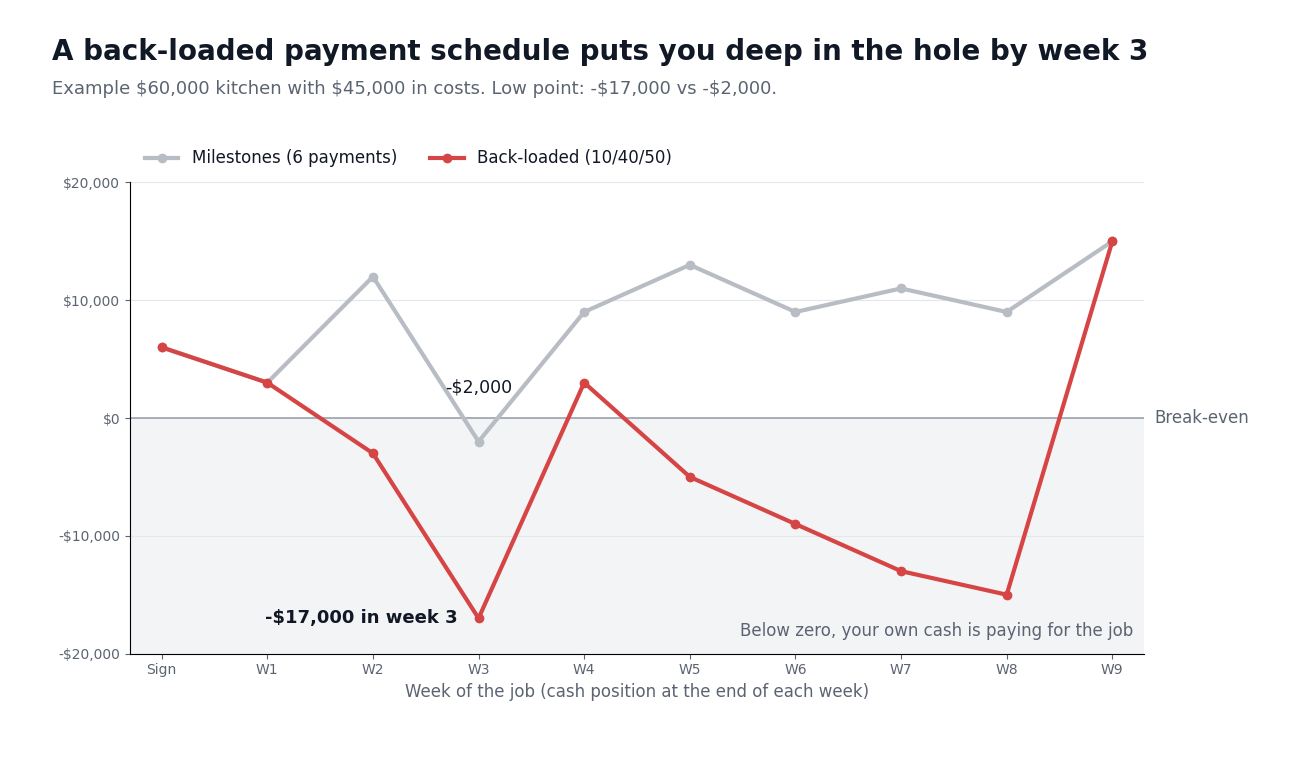
Same job, same costs, same total price. The only difference is timing. With the back-loaded schedule, you carry the job through the cabinet and countertop weeks with your own cash; with milestone billing, the payments arrive close to the costs they cover. This example assumes a state without California’s $1,000 deposit cap.
Six ways to stop funding client renovations
1. Build the payment schedule around your costs
List the job’s big costs by week, then set milestones so a payment comes in before or right after each one. Cabinets, windows, and tile are the usual culprits. Our progress billing guide shows how to structure the schedule and what to tie each payment to.
2. Get paid for change orders when they are signed
Collect part or all of a change order when the homeowner signs it, especially for special-order materials. At the latest, bill it with the next milestone. Never let change orders wait for the final invoice.
3. Tighten your payment terms
- Payment due within a set number of days of each milestone, for example 5 business days
- Online card and bank payments, so paying takes a minute
- A clause that lets you pause work if a payment is late, after written notice
- Late fees where your state allows them
4. Use supplier terms instead of your cash
Open trade accounts with your main suppliers. Terms such as net 30 let you pay for materials after the homeowner’s matching payment comes in. Order materials to arrive close to when they are installed, not weeks early.
5. Let homeowners buy some big-ticket items directly
For appliances and sometimes plumbing fixtures, it can make sense for the homeowner to buy direct and have them delivered to the job. You give up any markup on those items, so use this for pass-through items, not the ones you earn on.
6. Invoice the day you hit the milestone
Send the invoice from the job site with photos of the finished stage. A milestone invoiced a week late is a week of financing you gave the homeowner for free.
A 15-minute weekly cash check
Every Monday, look eight weeks ahead. Most cash crunches are visible a month early if you write the numbers down.
- Start with the cash in the bank today.
- List payments coming in by the date each milestone will realistically be reached, not the hopeful date.
- List money going out: payroll, material orders, sub invoices, and overhead such as insurance, trucks, and rent.
- Find the low point. Mark the first week where cash drops below your floor, for example two payrolls plus a month of overhead.
- Fix it now. Bill an open change order, chase a late invoice, move a material order, or adjust a milestone with the homeowner before the week arrives.
Copy this layout into a spreadsheet. The example rows show the math, and week 3 is the warning:
Week of,Cash at start,Payments in,Payroll,Materials,Subs,Overhead,Cash at end
Oct 13,42000,15000,9500,12000,4000,3500,28000
Oct 20,28000,0,9500,6000,0,3500,9000
Oct 27,9000,18200,9500,2000,6500,3500,5700
In this example, cash falls to $5,700 in the third week, below a single payroll. Spotted on October 13, the fix is easy: bill the next milestone on time and push one material order a week.
Where software helps
The cash gap usually hides in delays: a change order nobody billed, an invoice sent a week late, a receipt that never reached the job. Software built for project work closes those delays.
MotionOps keeps the whole job in one system for contractors whose jobs run for days or weeks:
- Change orders signed on a phone, so extra work is approved and ready to bill the same day
- Invoices, online payments, and a customer portal link for the homeowner
- Payment reminders and follow-ups by email or text
- Materials, receipts, and expenses tracked by job, so you see what each job has cost so far
- Job profitability for every active project
Try MotionOps free for 14 days and run your next job’s billing from it.
FAQ
Why is my remodeling business profitable but always out of cash?
Profit is measured over the whole job. Cash is measured week by week. If your costs come due weeks before the matching payments, you can be profitable and short on cash at the same time, and growing faster makes the gap bigger.
What is construction cash flow?
Construction cash flow is the timing of money coming in from clients and going out to payroll, suppliers, and subs on each job. Positive cash flow means payments arrive before or with the costs they cover.
How much cash should a contractor keep in reserve?
Pick a floor you never want to drop below and check it every week. A common starting point is two payrolls plus a month of overhead; adjust it to the size and length of your jobs.
Should I use a line of credit to cover cash gaps?
A business line of credit can smooth short timing gaps, such as a slow-paying milestone. It should not be how you fund every job. If you draw on it for each project, fix the payment schedule first.
Can I ask for a bigger deposit to cover materials?
It depends on your state. California caps home improvement deposits at $1,000 or 10% of the contract, whichever is less, and bars billing for materials before they are delivered. Check your state’s rules before you raise deposits.