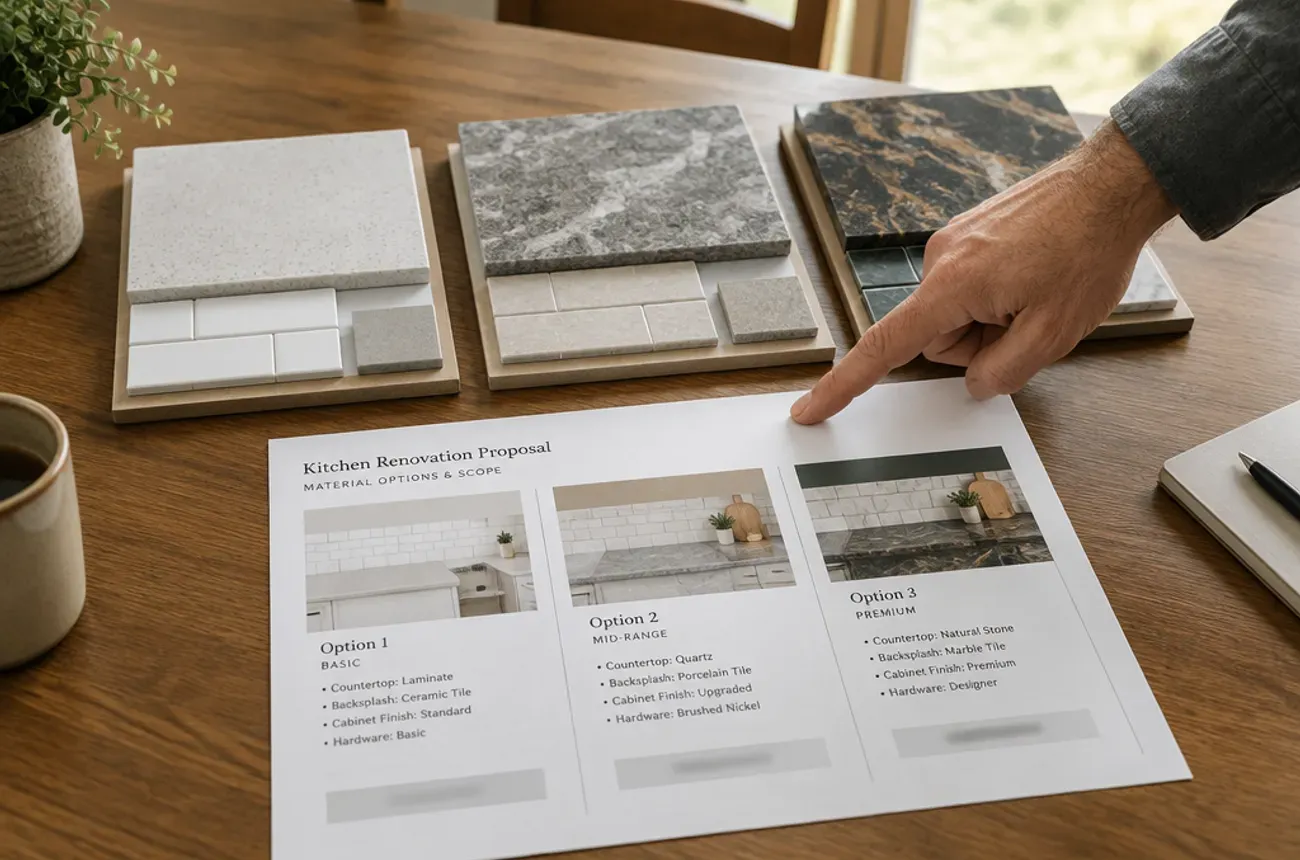
Offering three prices works because it changes the homeowner’s question from “Should I hire this contractor?” to “Which option do I want?” Good, better, and best options also give a price-sensitive homeowner a way to say yes, and a homeowner with a bigger budget a reason to spend it. You don’t need three estimates to do it: build one base scope, then vary finishes and add-ons on top of it.
This guide shows how to structure three options, a worked bathroom example, and how to present them so the middle option does its job.
Build one scope, then three options
The mistake that makes this feel like triple the work is pricing three different projects. Instead:
- Price the base scope once. Demo, rough-ins, framing, drywall, and labor stay the same in every option.
- Pick the two or three things that change the most: finishes, fixtures, and one or two add-ons.
- Build each option as the base plus a set of choices. Good uses standard finishes, better uses mid-grade finishes plus one upgrade, best uses premium finishes plus the add-ons.
- Save it as a template so the next bathroom takes minutes.
Worked example: a primary bathroom
The figures below are illustrative; use your own costs and markup.
| Good | Better | Best | |
|---|---|---|---|
| Base scope (demo, plumbing and electrical rough-in, drywall, labor) | Included | Included | Included |
| Tile | Standard porcelain, floor and tub surround | Large-format porcelain, walk-in shower | Natural stone, floor-to-ceiling in shower |
| Vanity | Stock 48-inch vanity | Semi-custom 60-inch double vanity | Custom vanity with quartz top |
| Fixtures | Standard chrome | Brushed finish, rain shower head | Thermostatic valve, body sprays |
| Add-ons | — | Heated floor | Heated floor, niche lighting, frameless glass |
| Price | $18,500 | $24,900 | $32,000 |
The middle option should be the one you’d recommend to most clients: a clear step up from good, without the full cost of best.
How to present three options
- Present in person or on a call. A PDF with three prices and no explanation invites the homeowner to pick the cheapest.
- Start with what they told you. “You said the shower matters most, so here’s what each option does for the shower.”
- Describe outcomes, not part numbers. “A walk-in shower with no curb” means more than a model number.
- Show what changes between options. Highlight only the differences so the choice is easy.
- Keep it to three. More options slow the decision down.
- Make each option a real recommendation. Never include an option you wouldn’t be happy to build.
When not to offer three options
- Repairs and fixed-scope work, where there’s really one right way to do the job.
- Insurance work, where scope is set by the claim.
- Clients who asked for one specific scope, such as a design they already chose with an architect.
After they choose
The chosen option becomes the contract scope, and anything they add later is a change order. Our guide to change orders covers how to handle upgrades that come up mid-job.
Where MotionOps fits
MotionOps keeps proposals, signatures, and the job in one place, for contractors whose jobs run for days or weeks:
- Proposal builder for building and sending proposals
- E-signatures, so the homeowner approves the option they chose from their phone
- Change orders for upgrades added after signing
- Job profitability, so you can see which option actually earns the most
Try MotionOps free for 14 days and send your next proposal from it.