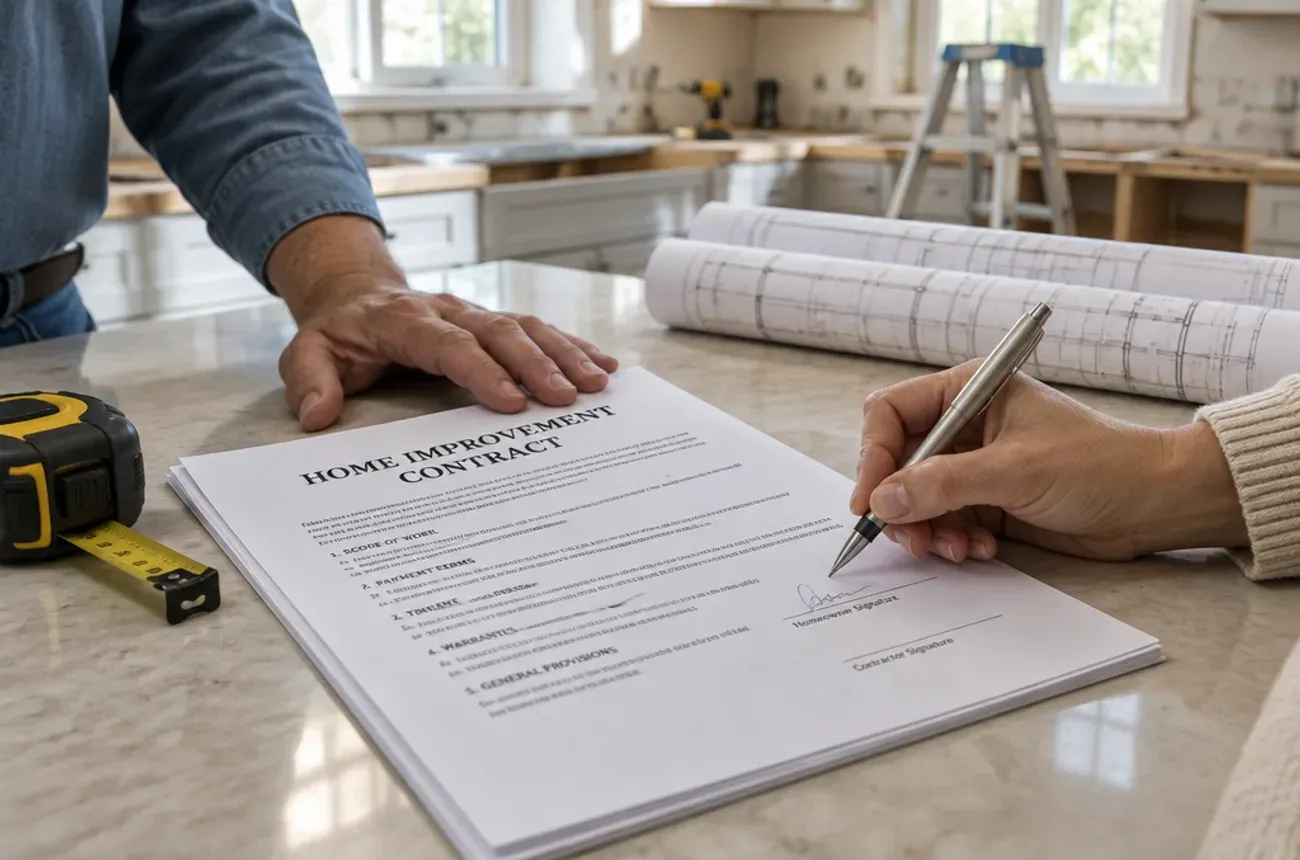
Every home improvement company needs a written, signed contract on every job, because it is the only document that fixes the scope, the price, the payment schedule, and what happens when something changes. In some states it is also the law: California, for example, requires a written home improvement contract for jobs over $500.
This guide explains what a signed contract protects, the sections every home improvement contract should have, a fill-in template, and sample language for two clauses most templates skip: price escalation and homeowner-supplied materials.
Why contract signing matters in construction
A signed contract turns a handshake into a set of rules both sides agreed to before anyone was upset. On a remodel that runs for weeks, those rules decide most of the arguments before they start.
- It defines the job. Scope, materials, and finishes in writing mean “I thought that was included” has an answer.
- It sets the price and how it changes. The contract price is the baseline every change order is measured against.
- It gets you paid on schedule. Deposit, progress payments, and the final payment are tied to milestones both sides signed.
- It covers the unknowns. Hidden conditions, allowances, and material price changes have a process instead of a fight.
- It protects your lien rights and your license. Many states require specific contract terms or notices, and missing them can weaken your right to collect or lead to discipline.
- It sets expectations. Homeowners who read the schedule, the payment terms, and the change order process at signing are calmer during the job.
A quote the homeowner accepted by text is not a contract. Neither is an estimate with a signature line but no terms. If it doesn’t say what happens when something changes, it won’t protect you when something does.
What to include in a home improvement contract
These are the sections a remodeling contract should cover. Your state may require more, plus exact wording for some notices.
| Section | What it covers |
|---|---|
| Parties and license | Your company name, address, and license number; the owner’s name and the job address |
| Scope of work | What you will do, room by room, specific enough that a stranger could check it |
| Materials and finishes | Brands, models, and grades for significant materials, or allowances where the owner still has to choose |
| Contract price | The total price in dollars and cents |
| Payment schedule | Deposit and each progress payment, tied to a described stage of work |
| Schedule | Approximate start and completion dates, and what counts as starting |
| Change orders | Changes only by written, signed change order showing scope, price, and schedule effect |
| Allowances | Dollar amounts for owner selections and how overages are billed |
| Hidden conditions | How rot, old wiring, or other surprises found during the work are handled and priced |
| Permits and inspections | Who pulls permits and pays fees |
| Owner responsibilities | Access, utilities, clearing work areas, decisions by set dates |
| Completion and punch list | What “substantially complete” means and how the punch list and final payment work |
| Warranty | What you warrant, for how long, and what is excluded |
| Insurance | Your liability and workers’ comp coverage |
| Termination and disputes | When either side can end the contract, and how disputes are resolved |
| Required notices | Right to cancel, lien warnings, and other notices your state requires |
| Signatures and dates | Both parties, before any work starts |
Free home improvement contract template
Use this outline as a starting point. Fill in the brackets, add any notices your state requires, and have a construction attorney in your state review it before you use it. It is a template, not legal advice.
# HOME IMPROVEMENT CONTRACT

Contractor: [Company name], [address], License #[number]
Owner: [Name(s)]
Job address: [Address]
Contract date: [Date]

## 1. Scope of work
[Room-by-room description of the work.]

## 2. Materials and finishes
[Significant materials by brand, model, and grade.]
Allowances: [Item] $[amount]; [Item] $[amount].
Selections over an allowance are billed by change order at cost plus [__]%.

## 3. Contract price
$[amount]

## 4. Payment schedule
Deposit at signing: $[amount]
Payment 2, due when [stage] is complete: $[amount]
Payment 3, due when [stage] is complete: $[amount]
Final payment, due at substantial completion: $[amount]
Payments are due within [5] business days of each stage.

## 5. Schedule
Approximate start: [date]. Work has started when [definition].
Approximate completion: [date].

## 6. Change orders
Changes to scope, price, or schedule are made only by a written change order
signed by both parties before the changed work starts. Each change order states
the scope, the amount added or subtracted, and its effect on the payment
schedule and completion date.

## 7. Hidden conditions
If concealed conditions are found, Contractor will stop affected work, document
them, and propose a change order before proceeding.

## 8. Price escalation (see sample clause)
## 9. Owner-supplied materials (see sample clause)

## 10. Permits and inspections
[Contractor / Owner] obtains permits. Permit fees are [included / extra].

## 11. Owner responsibilities
Access, utilities, and clear work areas by [time]; selections by [dates].

## 12. Completion, punch list, and final payment
[Substantial completion and punch list clause.]

## 13. Warranty
[Coverage, length, exclusions.]

## 14. Insurance
Contractor carries general liability and workers' compensation insurance.

## 15. Payment default
If a payment is more than [__] days late, Contractor may stop work after
written notice until it is paid.

## 16. Disputes
[Mediation first; then arbitration or court in [county, state].]

## 17. Required notices
[Right to cancel, lien notices, and other notices required in your state.]

Signed before work starts:
Contractor: __________ Date: ______
Owner: __________ Date: ______
Clauses that prevent the most disputes
Most remodeling disputes come from five moments: a change, a surprise behind the wall, a selection over budget, a late payment, and the end of the job. Each needs its own clause.
| Moment | Clause | What it says |
|---|---|---|
| The homeowner wants something different | Change orders | No changed work without a signed change order showing price and schedule effect |
| Rot or bad wiring behind the wall | Hidden conditions | Work stops, you document it, and a change order prices the fix |
| Tile picked at twice the budget | Allowances | Overages billed by change order, with or without markup as stated |
| A payment is two weeks late | Payment default | Work can pause after written notice until the payment arrives |
| “It’s not done” at the end | Completion and punch list | A defined substantial completion, a signed punch list, and a holdback for open items |
We cover two of these in depth: change orders and the punch list and final payment.
Price escalation clause for residential remodels
A price escalation clause lets you pass on a large, documented increase in material prices that happens between signing and buying the materials. In 2026 it has gone from rare to reasonable: as reported in June 2026, construction input prices rose more in the first four months of the year than in the prior three years, and framing lumber was up more than 30% from its December low.
When to use one
- Jobs signed weeks or months before materials are bought
- Price-sensitive materials such as lumber, steel, copper wire, and some imported products
- Long projects, such as additions, where purchases are spread over months
Sample escalation clause
Bring this to your attorney and adapt it to your state:
Material price escalation. The contract price is based on supplier prices on [date] for the materials listed in Exhibit A. If the cost of any listed material rises by more than [5]% between that date and the date Contractor buys it, Contractor may adjust the contract price by the documented increase, at cost and without markup, by written change order with supplier invoices or quotes attached. Decreases of more than [5]% will be credited to Owner the same way. If total increases under this clause exceed [__]% of the contract price, Owner may choose substitute materials or end the contract and pay for work completed and materials delivered.
Make it fair, or it won’t hold up with homeowners
- List the materials. A clause that covers “all materials” reads like a blank check.
- Set a threshold. Small changes stay your risk; only meaningful jumps pass through.
- Pass through at cost. No markup on the increase.
- Credit decreases too. Homeowners accept a two-way clause far more easily.
- Use a change order. In states such as California, any change to the contract price must be in a signed written change order.
- Lock prices where you can. Buying key materials early or getting longer quote validity from suppliers can make the clause unnecessary.
Homeowner-supplied materials policy
When a homeowner buys their own faucet, tile, or light fixtures, three things usually go wrong: you lose the margin you earn on materials, the item arrives late, wrong, or damaged, and when it fails, nobody agrees whose fault it is. A written policy fixes all three before the job starts.
Decide what you will accept
- Allowed with the clause below: finish items such as light fixtures, faucets, hardware, and appliances
- Not allowed, or only with approval: items you warrant or that affect structure and water, such as shower valves, waterproofing, and framing
How to price labor-only work
Material markup is part of how a job covers overhead. When the homeowner supplies an item, recover part of that with a material coordination fee, and price the install at your full labor rate.
| Line | You supply the tile | Homeowner supplies the tile |
|---|---|---|
| Tile | $3,000 at cost, sold at your margin | Bought by homeowner |
| Install labor | Your normal price | Your normal price |
| Coordination fee | None | Example: 15% of the material’s value, $450 |
| What the fee covers | Checking the order, receiving and storing it, handling returns and delays |
Sample owner-supplied materials clause
Owner-supplied materials. Owner may supply the following items: [list]. Owner is responsible for ordering the correct items and quantities and for delivery to the job by [date]. Contractor will inspect items on arrival and notify Owner of visible damage or missing parts. Delays caused by late, wrong, or damaged owner-supplied items may extend the schedule and may be billed as a change order. Contractor warrants its installation workmanship but not the owner-supplied items themselves; manufacturer defects are handled under the manufacturer’s warranty. A material coordination fee of [__]% of the items’ value applies.
Have your attorney review the clause, especially the warranty language, before you use it.
State rules: California as an example
Many states regulate home improvement contracts, and some spell out exact headings, notices, and type sizes. California is one of the most detailed. Under Cal. Bus. & Prof. Code § 7159, contracts over $500 must be written and signed before work starts, and must include:
| Requirement | What California asks for |
|---|---|
| Identification | Contractor name, business address, and license number; salesperson details if one sold the job |
| Heading and copy notice | A “Home Improvement” heading and a statement that the buyer is entitled to a completed, signed copy before work starts |
| Price and project | The contract price and a description of the project and significant materials and equipment |
| Down payment | No more than $1,000 or 10% of the price, whichever is less, with a required notice |
| Progress payments | A schedule that ties each payment to specific work, with a notice that billing ahead of the work is illegal |
| Dates | Approximate start and completion dates, and what counts as starting |
| Change orders | A note that extra work and change orders must be written and signed first |
| Insurance notices | Whether you carry general liability and workers’ comp insurance |
| Lien warning | A mechanics lien warning in the wording the law sets |
| Right to cancel | A three-day right to cancel in most cases, five days for senior citizens |
| Subcontractors | Whether subcontractors will be used |
Other states have their own lists, and federal rules can also give buyers a short window to cancel some sales made at their home. Before you finalize your template, check your state contractor board’s requirements or have a construction attorney review it. This section is general information, not legal advice.
Where software helps
A good contract only protects you if it is signed before work starts and every later change is signed too. Paper contracts in a truck make both harder.
MotionOps handles the paperwork for contractors whose jobs run for days or weeks:
- Proposal builder that turns your estimate into a proposal the homeowner can review
- Contracts signed electronically on a phone or computer, before work starts
- Change orders sent by email or text and signed on the job
- Everything stored with the job, so the signed contract and every change order are one tap away when questions come up
Try MotionOps free for 14 days and send your next contract for e-signature.